O Levels/IGCSE Economics (2281)•2281/12/O/N/23
O Levels/IGCSE Economics (2281) — 2281/12/O/N/23, Question 6
The markets of four products are all in equilibrium. The table gives the value of the price elasticity of supply (PES) for each product in equilibrium. The demand for each product shifts to the right by 5 units at all prices. Which product will have the largest price increase?
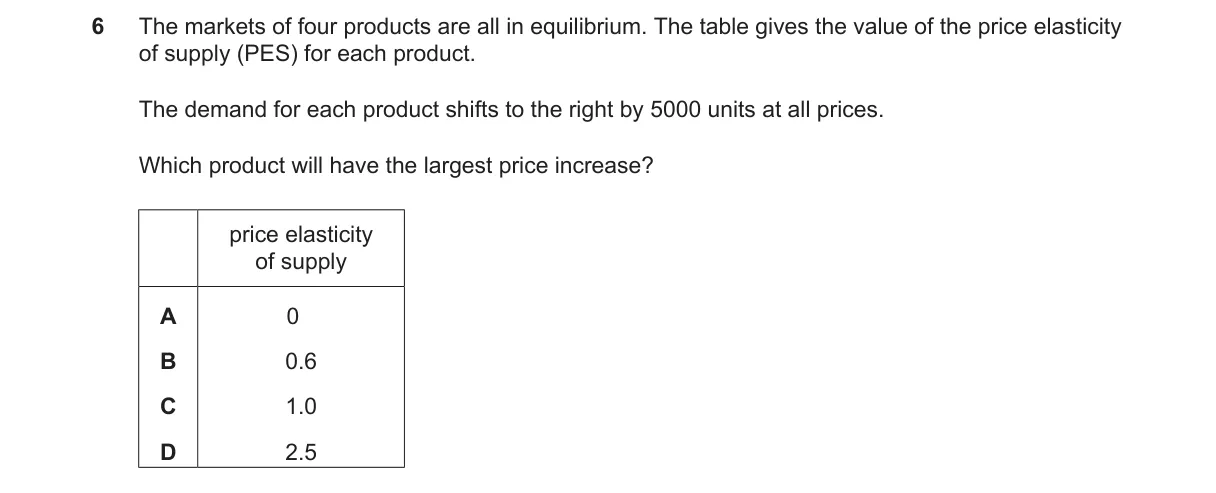
Answer choices
- A0
- B0.6
- C1.5
- D2.5
Explanation
Price rise is inversely related to supply elasticity
Steps:
- Demand shifts right by 5 units, creating excess demand at initial price.
- New equilibrium requires supply to increase by 5 units.
- PES = (%ΔQ_s / %ΔP); for fixed ΔQ=5, lower PES requires larger %ΔP.
- Thus, smallest PES yields largest price increase.
Why A is correct:
- PES=0 means perfectly inelastic supply (vertical curve); entire demand shift absorbed by price rise, per elasticity definition.
Why the others are wrong:
- B: PES=0.6 allows some quantity response, reducing needed price rise.
- C: PES=1.5 is more elastic than B, enabling larger quantity increase and smaller price rise.
- D: PES=2.5 is most elastic, maximizing quantity response and minimizing price rise.
Final answer: A
Topic: Price elasticity of supply (PES)
Practice more O Levels/IGCSE Economics (2281) questions on mMCQ.me