O Levels/IGCSE Economics (2281)•2281/12/O/N/23
O Levels/IGCSE Economics (2281) — 2281/12/O/N/23, Question 26
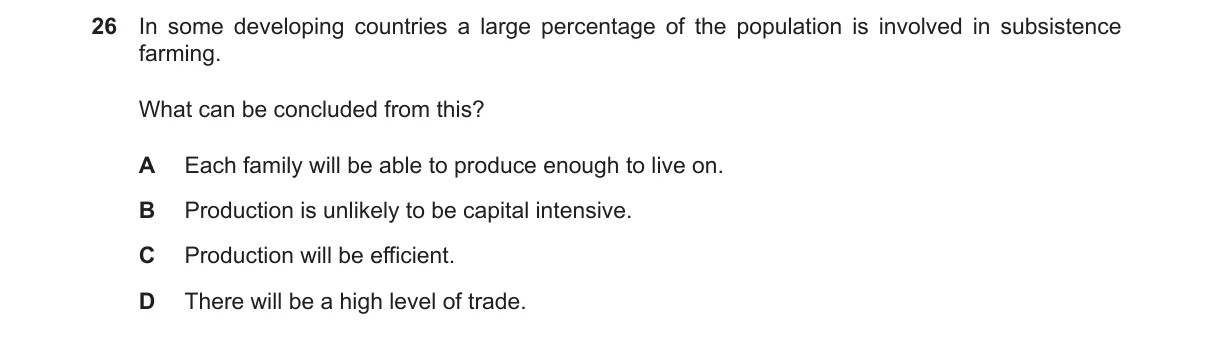
In some developing countries a large percentage of the population is involved in subsistence farming. What can be concluded from this?
Answer choices
- AEach family will be able to produce enough to live.
- BProduction is unlikely to be capital intensive.
- CProduction will be efficient.
- DThere will be high level of trade.
Explanation
Subsistence farming relies on family labor over capital investment
Steps:
- Define subsistence farming as producing food mainly for family consumption, not surplus for sale.
- Recognize that in developing countries, this often involves limited resources and technology.
- Link high population involvement to low mechanization, favoring manual methods.
- Conclude that capital-intensive production (e.g., machinery) is improbable due to cost barriers.
Why B is correct:
- Subsistence farming, by definition, uses minimal capital inputs like tools or equipment, relying instead on abundant family labor to keep costs low.
Why the others are wrong:
- A: Families may face shortages from poor yields or weather, not guaranteeing self-sufficiency.
- C: Efficiency is not assured; methods are often traditional and low-yield without modern inputs.
- D: Little surplus exists for trade, leading to minimal commercial exchange.
Final answer: B
Topic: Differences in economic development between countries
Practice more O Levels/IGCSE Economics (2281) questions on mMCQ.me