O Levels/IGCSE Economics (2281)•2281/13/O/N/22
O Levels/IGCSE Economics (2281) — 2281/13/O/N/22, Question 1
The Chinese government is concerned about the level of poverty, and the need for more resources in low-income regions of the country. As a result, it is increasing its expenditure in those regions and reducing it in high-income regions. Which economic concept does this government policy illustrate?
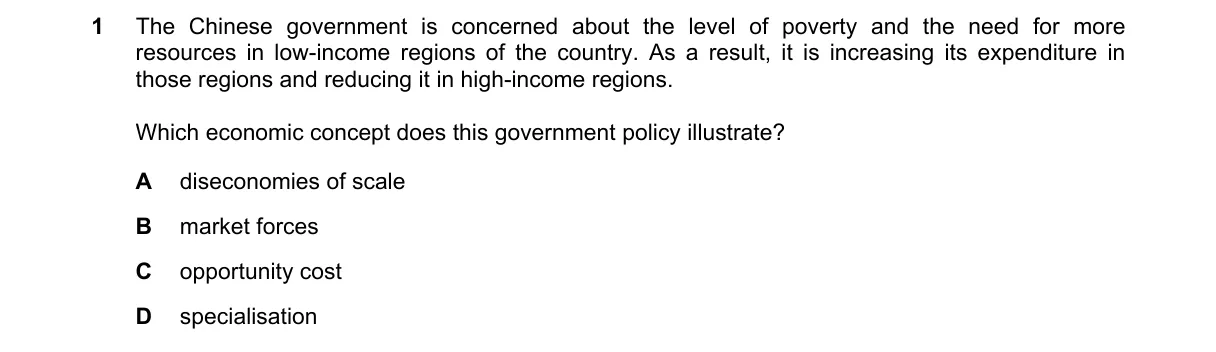
Answer choices
- Amarket forces
- Beconomies of scale
- Copportunity cost
- Dspecialisation
Explanation
Government policy shows trade-offs in resource allocation
Steps:
- Identify the policy: reallocating government spending from high-income to low-income regions to address poverty.
- Recognize the implication: increasing expenditure in one area requires reducing it elsewhere due to limited total budget.
- Link to economic concepts: this highlights the trade-off where choosing one option means forgoing another.
- Match to choices: the concept of forgoing alternatives fits opportunity cost.
Why C is correct:
- Opportunity cost is the value of the next best alternative forgone; here, reducing spending in high-income regions is the cost of prioritizing low-income areas.
Why the others are wrong:
- A: Market forces involve supply and demand driving outcomes, but this is deliberate government intervention.
- B: Economies of scale refer to cost reductions from increased production volume, unrelated to budget redistribution.
- D: Specialisation involves focusing on specific tasks or products for efficiency, not regional spending shifts.
Final answer: C
Topic: Opportunity cost
Practice more O Levels/IGCSE Economics (2281) questions on mMCQ.me