O Levels/IGCSE Economics (2281)•2281/12/O/N/22
O Levels/IGCSE Economics (2281) — 2281/12/O/N/22, Question 23
The table shows changes in economic growth and inflation. Which changes are likely to be the result of rising unemployment?
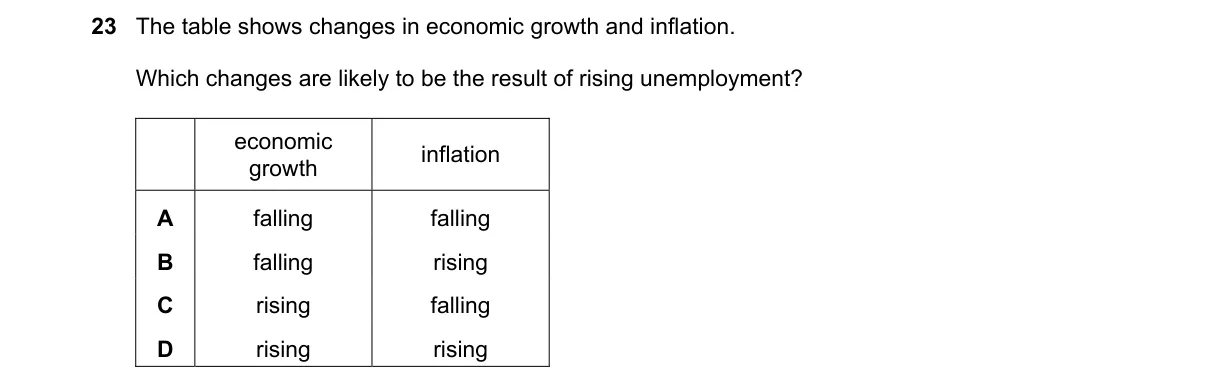
Answer choices
- Aeconomic growth falling inflation falling
- Beconomic growth falling inflation rising
- Ceconomic growth rising inflation falling
- Deconomic growth rising inflation rising
Explanation
Rising unemployment signals a recession with falling demand
Steps:
- Rising unemployment reduces consumer and business spending, slowing economic growth.
- Slower growth means less demand for goods and services, putting downward pressure on prices.
- This leads to falling inflation as the economy contracts.
- Thus, both economic growth and inflation decline together.
Why A is correct:
- In Okun's law, rising unemployment correlates with falling GDP growth, and reduced demand causes disinflation per the Phillips curve short-run tradeoff.
Why the others are wrong:
- B: Falling growth with rising inflation indicates stagflation, not typical of rising unemployment alone.
- C: Rising growth contradicts unemployment increases, which signal economic contraction.
- D: Rising growth and inflation suggest economic expansion with low unemployment.
Final answer: A
Topic: Employment and unemployment
Practice more O Levels/IGCSE Economics (2281) questions on mMCQ.me