O Levels/IGCSE Economics (2281)•2281/13/O/N/20
O Levels/IGCSE Economics (2281) — 2281/13/O/N/20, Question 23
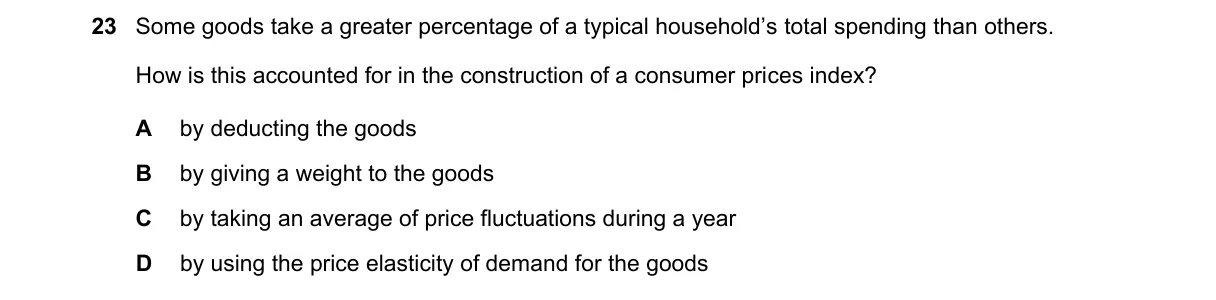
Some goods take a greater percentage of a typical household's total spending than others. How is this accounted for in the construction of a consumer prices index?
Answer choices
- Aby deducting the goods
- Bby giving a weight to the goods
- Cby taking average of price fluctuations during a year
- Dby using price elasticity of demand for the goods
Explanation
Weighting Goods by Spending Share in CPI
Steps:
- Identify the purpose of CPI: measures average price changes for a basket of goods and services.
- Recognize that spending patterns vary: some goods like housing consume more budget than others like candy.
- Recall CPI construction: uses a fixed basket weighted by expenditure proportions from surveys.
- Determine the method: higher-spending goods get higher weights to reflect their economic impact.
Why B is correct:
- CPI formula assigns weights based on average household expenditure shares, ensuring the index accurately tracks cost-of-living changes (e.g., Laspeyres index: ∑(p_t * q_0 * w_i) / ∑(p_0 * q_0 * w_i), where w_i is the weight).
Why the others are wrong:
- A: Deducting goods would exclude items, distorting the basket's representativeness.
- C: Averaging price fluctuations ignores spending proportions, leading to unweighted volatility.
- D: Price elasticity measures demand responsiveness, not spending shares for indexing.
Final answer: B
Topic: Inflation and deflation
Practice more O Levels/IGCSE Economics (2281) questions on mMCQ.me