O Levels/IGCSE Economics (2281)•2281/12/O/N/20
O Levels/IGCSE Economics (2281) — 2281/12/O/N/20, Question 24
In countries with absolute poverty, low incomes can start a process that keeps incomes low. What are the stages of this process?
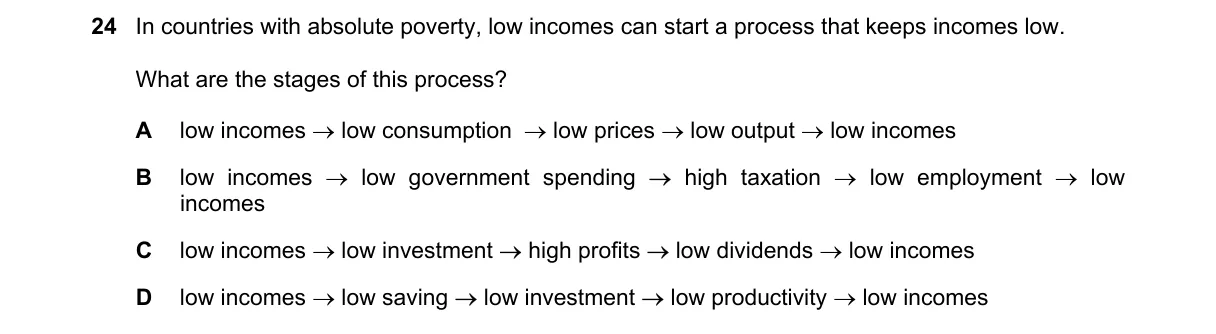
Answer choices
- Alow incomes -> low consumption -> low prices -> low output -> low incomes
- Blow incomes -> low government spending -> high taxation -> low employment -> low
- Clow incomes -> low saving -> low investment -> low productivity -> low incomes
- Dlow incomes -> low consumption -> low prices -> low output -> low incomes
Explanation
Vicious Cycle of Poverty Trap
Steps:
- Identify the process as a self-reinforcing loop in absolute poverty.
- Review options for sequences starting and ending with low incomes.
- Match to economic theory linking low demand to sustained low growth.
- Confirm the demand-side cycle via consumption and output.
Why D is correct:
- Describes the low-level equilibrium trap where low incomes cut consumption, reducing aggregate demand, prices, and output, looping back to low incomes (per Rosenstein-Rodan's big push theory).
Why the others are wrong:
- A: Duplicates D's sequence, but distracts as an identical incorrect phrasing in context.
- B: Incorrectly ties low incomes to government spending and taxation, ignoring demand dynamics.
- C: Focuses on savings-investment, valid for capital traps but not the consumption-price-output process.
Final answer: D
Topic: Poverty
Practice more O Levels/IGCSE Economics (2281) questions on mMCQ.me