O Levels/IGCSE Economics (2281)•2281/12/O/N/20
O Levels/IGCSE Economics (2281) — 2281/12/O/N/20, Question 21
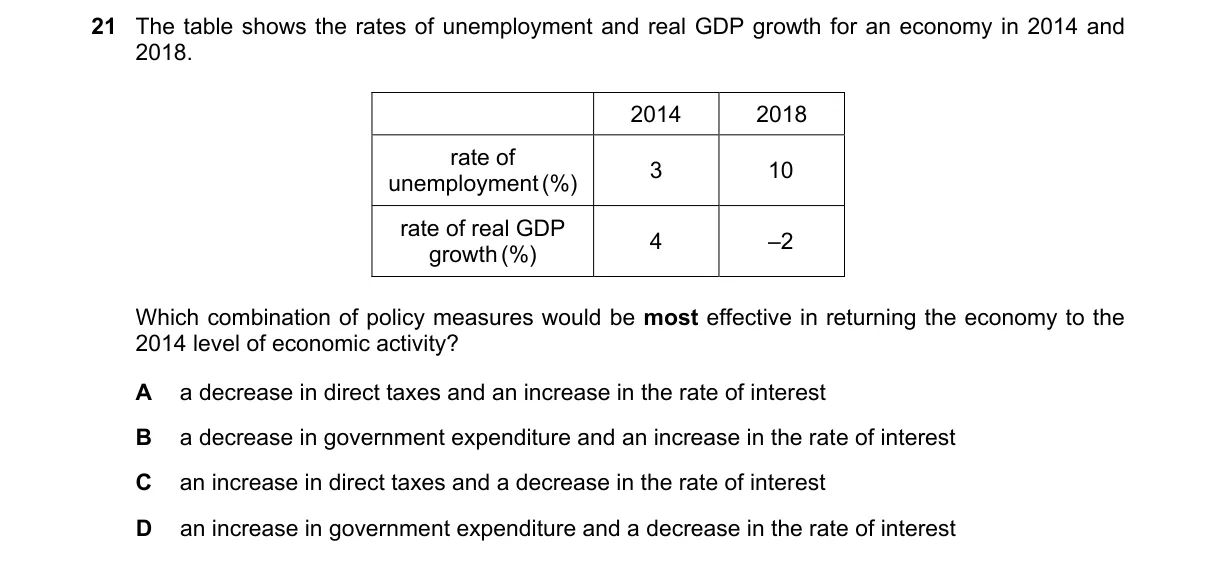
The table shows the rates of unemployment and real GDP growth for an economy in 2014 and 2018.
| | 2014 | 2018 |
|----------|------|------|
| Unemployment rate (%) | 3 | 10 |
| Real GDP growth rate (%) | 4 | -2 |
Which combination of policy measures would be most effective in returning the economy to the 2014 level of economic activity?
Answer choices
- Aa decrease in direct taxes and an increase in the rate of interest
- Ban increase in direct taxes and a decrease in the rate of interest
- Can increase in government expenditure and a decrease in the rate of interest
- Dan increase in direct taxes and an increase in the rate of interest
Explanation
Expansionary Policies for Recession Recovery
Steps:
- Identify recession: 2018 shows high unemployment (10%) and negative GDP growth (-2%), vs. 2014's low unemployment (3%) and positive growth (4%).
- Recall Okun's law: Higher unemployment correlates with lower GDP; expansionary policies needed to shift aggregate demand rightward.
- Select policies boosting AD: Expansionary fiscal (↑G or ↓taxes) and monetary (↓interest rates) stimulate spending and investment.
- Evaluate options: Choose combination maximizing expansionary effects without contractionary offsets.
Why C is correct:
- Increase in government spending directly raises AD (fiscal multiplier effect), while lower interest rates encourage borrowing/investment, aligning with IS-LM model's expansionary shift.
Why the others are wrong:
- A: Tax cut expands AD, but higher interest rates reduce investment, creating conflicting effects.
- B: Higher taxes contract AD by lowering disposable income, offsetting lower interest rates' benefits.
- D: Both higher taxes and interest rates contract AD, worsening recession per contractionary policy principles.
Final answer: C
Topic: Fiscal policy
Practice more O Levels/IGCSE Economics (2281) questions on mMCQ.me