O Levels/IGCSE Economics (2281)•2281/13/O/N/18
O Levels/IGCSE Economics (2281) — 2281/13/O/N/18, Question 25
What describes absolute and relative poverty?
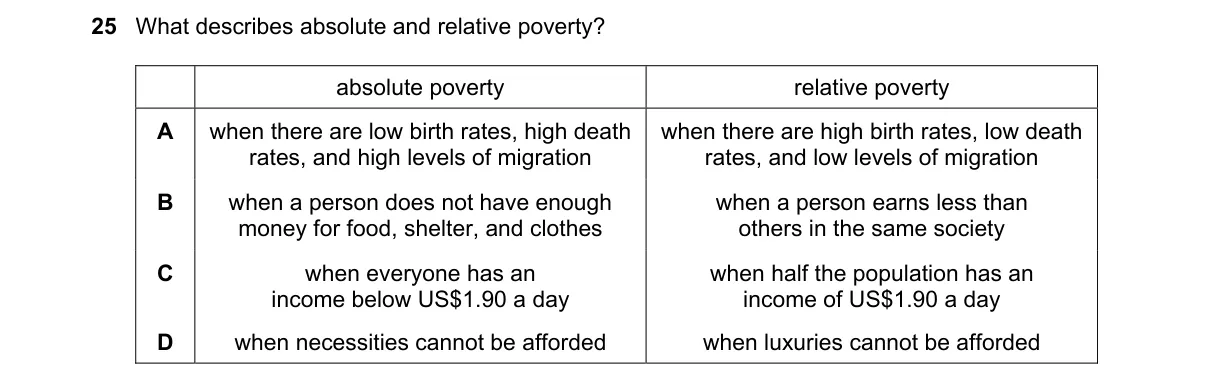
Answer choices
- Awhen there are low rates, and high levels of migration | when there are low rates, and low levels of migration
- Bwhen a person does not have enough money for food, clothes | when half the population has less than
- Cwhen income below US$1 a day | when luxuries cannot be afforded
- Dwhen necessities cannot be afforded | when luxuries cannot be afforded
Explanation
Distinguishing Absolute vs. Relative Poverty Definitions
Steps:
- Recall absolute poverty as inability to meet basic needs like food and shelter, independent of society.
- Recall relative poverty as income below a societal benchmark, such as 50% of median income.
- Compare choices to these definitions, focusing on first part for absolute and second for relative.
- Select the choice that precisely matches both concepts without extraneous details.
Why B is correct:
- Absolute poverty is lacking funds for essentials like food and clothes; relative poverty is having less than half the population's median income, per standard economic definitions.
Why the others are wrong:
- A confuses poverty with migration rates, unrelated to income thresholds.
- C limits absolute to a specific $1/day metric, ignoring broader necessities; relative part is vague.
- D incorrectly equates both to necessities, while relative involves societal standards beyond basics.
Final answer: B
Topic: Poverty
Practice more O Levels/IGCSE Economics (2281) questions on mMCQ.me