O Levels/IGCSE Economics (2281)•2281/13/O/N/18
O Levels/IGCSE Economics (2281) — 2281/13/O/N/18, Question 2
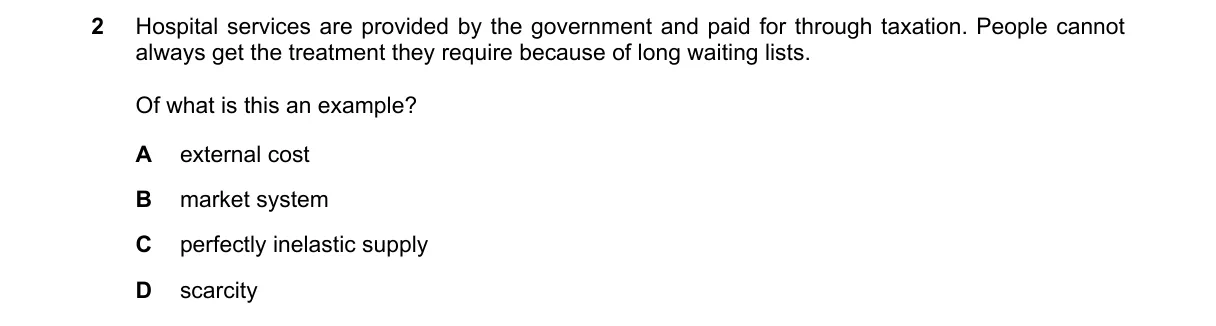
Hospital services are provided by the government and paid for through taxation. People cannot always get the treatment they require because of long waiting lists. Of what is this an example?
Answer choices
- Aexternal cost
- Bmarket system
- Cperfectly inelastic supply
- Dscarcity
Explanation
Government healthcare rationing due to limited resources
Steps:
- Recognize the system: public healthcare funded by taxes, not markets.
- Identify the issue: waiting lists limit access to needed treatments.
- Link to economics: unlimited demand for healthcare exceeds finite government resources.
- Conclude the concept: this reflects the core economic problem of resource limitation.
Why D is correct:
- Scarcity defines the economic condition where limited resources cannot satisfy all wants, causing rationing mechanisms like waiting lists in public systems.
Why the others are wrong:
- A: External costs involve unpriced spillovers (e.g., pollution), not access delays.
- B: Market system relies on price signals for allocation, absent in tax-funded government provision.
- C: Perfectly inelastic supply means fixed output regardless of price, but waiting lists stem from excess demand, not supply rigidity.
Final answer: D
[VIOLATION]
Topic: The nature of the economic problem
Practice more O Levels/IGCSE Economics (2281) questions on mMCQ.me