O Levels/IGCSE Economics (2281)•2281/13/O/N/18
O Levels/IGCSE Economics (2281) — 2281/13/O/N/18, Question 10
What would put a trade union in a strong bargaining position to negotiate higher wages for its members in a particular firm?
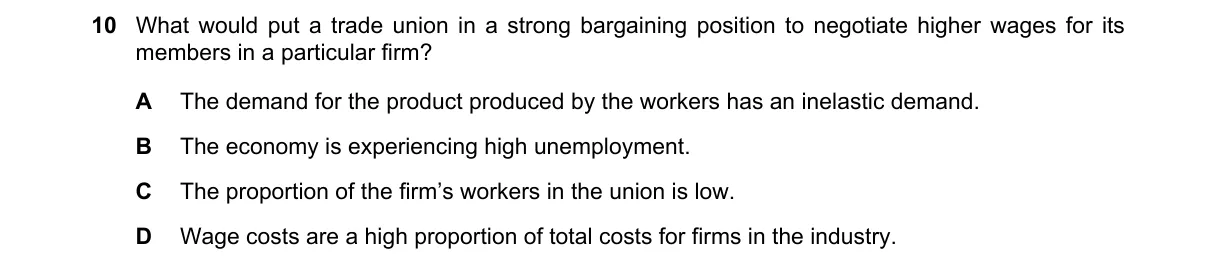
Answer choices
- AThe demand for the product produced by the workers has inelastic demand.
- BThe economy is experiencing high unemployment.
- CThe proportion of the firm's workers in the union is low.
- DWage costs are a high proportion of total costs for firms in the industry.
Explanation
Union bargaining power from product demand elasticity
Steps:
- Identify factors affecting union leverage: ability to raise wages without firm losing profits or sales.
- Evaluate product demand: inelastic demand allows price increases post-wage hikes with minimal quantity drop.
- Assess labor market conditions: strong union coverage and low unemployment enhance pressure.
- Compare cost structures: low wage share in costs makes hikes easier for firms to absorb.
Why A is correct:
- Inelastic demand means consumers buy similar quantities despite price rises, so firms pass wage costs to buyers without revenue loss (law of demand).
Why the others are wrong:
- B: High unemployment increases worker replacement ease, weakening union threats.
- C: Low union proportion reduces collective action and strike impact.
- D: High wage costs amplify profit squeeze from hikes, hardening firm resistance.
Final answer: A
Topic: Trade unions
Practice more O Levels/IGCSE Economics (2281) questions on mMCQ.me