O Levels/IGCSE Economics (2281)•2281/12/M/J/25
O Levels/IGCSE Economics (2281) — 2281/12/M/J/25, Question 21
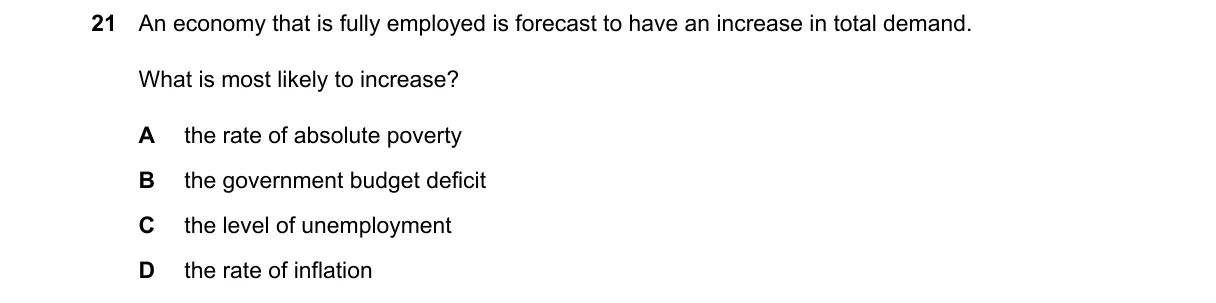
An economy that is fully employed is forecast to have an increase in total demand. What is most likely to increase?
Answer choices
- Athe rate of absolute poverty
- Bthe government budget deficit
- Cthe level of unemployment
- Dthe rate of inflation
Explanation
Demand-Pull Inflation at Full Employment
Steps:
- Recognize full employment means the economy operates at potential output with no spare capacity.
- An increase in total demand (aggregate demand) exceeds supply capacity.
- Output cannot rise significantly, so excess demand pushes prices upward.
- This results in higher inflation without changing employment levels.
Why D is correct:
- At full employment, increased aggregate demand causes demand-pull inflation, as defined in macroeconomic theory where price levels rise due to excess demand relative to supply.
Why the others are wrong:
- A: Rising demand boosts economic activity and incomes, likely reducing absolute poverty.
- B: No direct link to government spending or taxes; deficit depends on fiscal policy, not aggregate demand alone.
- C: Full employment implies unemployment at the natural rate, so it remains stable rather than increasing.
Final answer: D
Topic: Inflation and deflation
Practice more O Levels/IGCSE Economics (2281) questions on mMCQ.me