O Levels/IGCSE Economics (2281)•2281/11/M/J/25
O Levels/IGCSE Economics (2281) — 2281/11/M/J/25, Question 15
A firm chooses to become more capital-intensive. What is least likely to have increased?
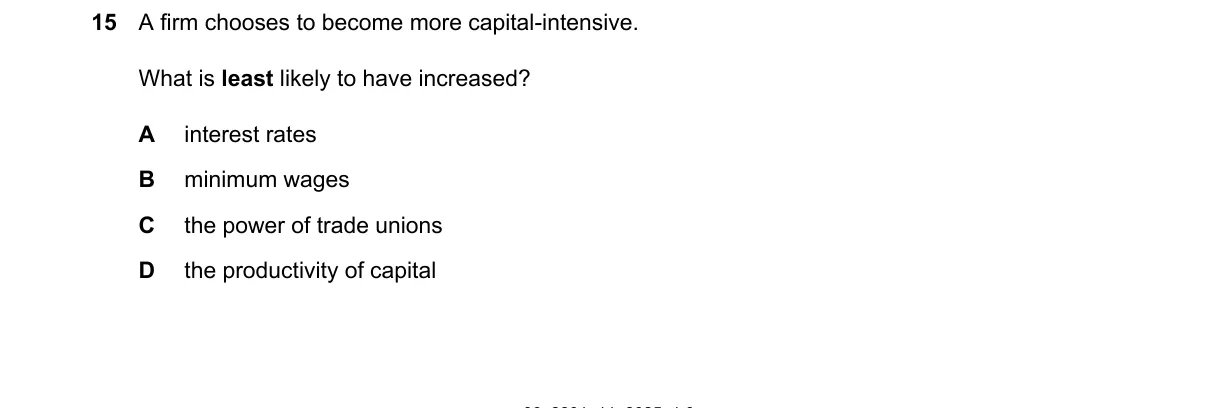
Answer choices
- Ainterest rates
- Bminimum wages
- Cthe power of trade unions
- Dthe productivity of capital
Explanation
Capital substitution driven by rising labor costs
Steps:
- Capital-intensive production increases the capital-to-labor ratio, substituting machines for workers.
- Firms choose this when labor costs rise faster than capital costs.
- Likely triggers include higher labor expenses from wages or unions, or better capital efficiency.
- Interest rates, as capital costs, rising would oppose this shift.
Why A is correct:
- Interest rates are the price of borrowing capital; their increase raises capital costs, making capital-intensification less attractive per basic production theory.
Why the others are wrong:
- B: Higher minimum wages directly elevate labor costs, incentivizing capital substitution.
- C: Greater union power boosts wage demands and labor restrictions, favoring capital use.
- D: Improved capital productivity enhances output per capital unit, encouraging more capital investment.
Final answer: A
Topic: Firms and production
Practice more O Levels/IGCSE Economics (2281) questions on mMCQ.me