O Levels/IGCSE Economics (2281)•2281/12/M/J/23
O Levels/IGCSE Economics (2281) — 2281/12/M/J/23, Question 24
During a recession, many people in a city become unemployed and their incomes fall. Some people can no longer pay rent on their houses or buy food they need. What is the effect of the recession in the city
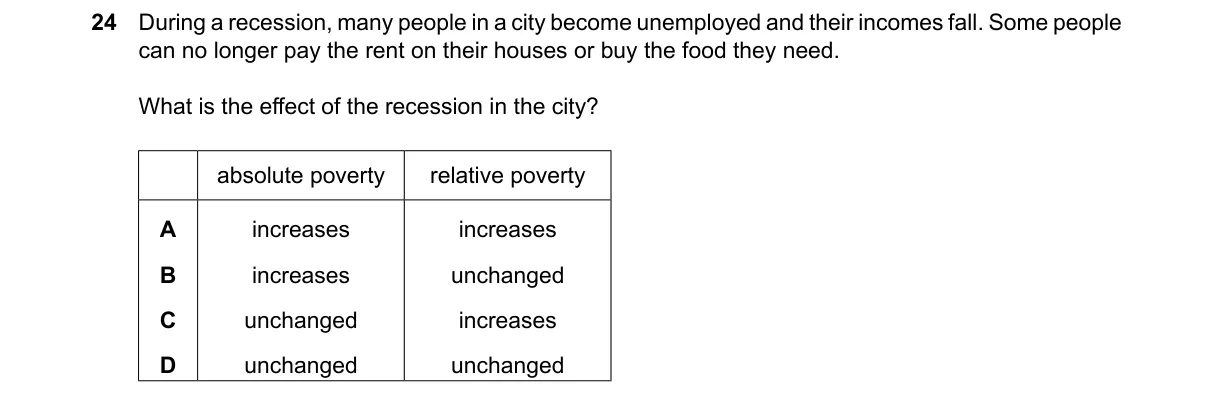
Answer choices
- Aabsolute poverty increases, relative poverty unchanged
- Babsolute poverty increases, relative poverty increases
- Cabsolute poverty unchanged, relative poverty increases
- Dabsolute poverty unchanged, relative poverty unchanged
Explanation
Recession's Impact on Absolute vs. Relative Poverty
Steps:
- Identify absolute poverty as inability to afford basic needs like food and shelter.
- Note recession causes widespread unemployment and income drops, pushing more below subsistence levels.
- Define relative poverty as income below a percentage of the society's median income.
- Recognize recession lowers most incomes proportionally, keeping relative income gaps stable.
Why A is correct:
- Absolute poverty increases because fixed basic needs thresholds are unmet by falling incomes; relative poverty remains unchanged as the income distribution shifts uniformly without widening gaps.
Why the others are wrong:
- B: Relative poverty does not increase, as proportional income drops preserve distribution.
- C: Absolute poverty increases due to unmet basic needs from income loss.
- D: Absolute poverty increases, so both cannot remain unchanged.
Final answer: A
Topic: Poverty
Practice more O Levels/IGCSE Economics (2281) questions on mMCQ.me