O Levels/IGCSE Economics (2281)•2281/11/M/J/23
O Levels/IGCSE Economics (2281) — 2281/11/M/J/23, Question 8
For some illnesses, wearing a face mask has a benefit as it could prevent people from getting infected. Not all people are willing to wear face masks. Based on the statement above, why would there be an inefficient allocation of face masks in the free market?
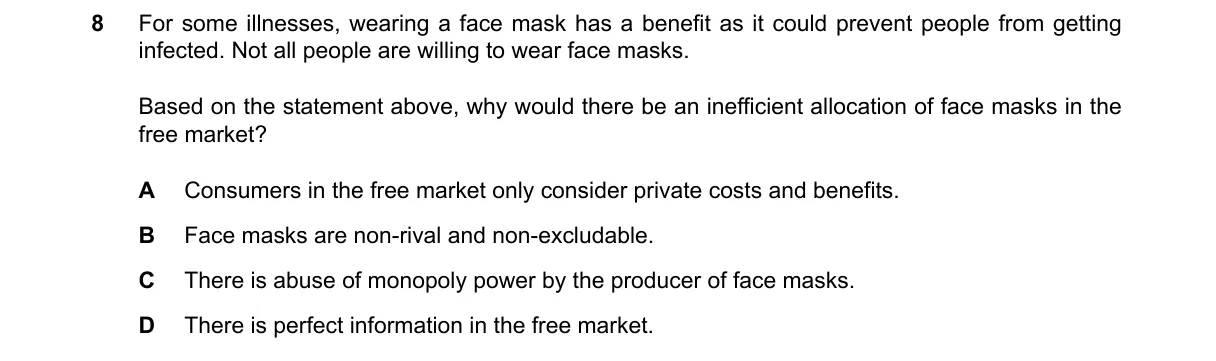
Answer choices
- AFace masks are non-rival and non-excludable.
- BThere is abuse of monopoly power by the producer of face masks.
- CThere is imperfect information in the free market.
- DThere is perfect information in the free market.
Explanation
Public Goods and Market Failure
Steps:
- Identify the benefit: Face masks prevent infection spread, benefiting society beyond the wearer.
- Recognize the issue: Not everyone wears them, leading to underuse despite collective gains.
- Classify the good: Face masks exhibit public good traits, causing free-rider problems.
- Conclude inefficiency: Free markets underprovide public goods due to non-excludability and non-rivalry.
Why A is correct:
- Public goods are non-rival (one person's use doesn't reduce availability for others) and non-excludable (hard to prevent non-payers from benefiting), leading to free-riding and inefficient allocation per economic theory.
Why the others are wrong:
- B: No evidence of monopoly; issue stems from good's nature, not producer power.
- C: Imperfect information isn't mentioned; reluctance ties to free-riding, not info gaps.
- D: Perfect information wouldn't fix public good underprovision; it exacerbates free-riding.
Final answer: A
Topic: Market failure
Practice more O Levels/IGCSE Economics (2281) questions on mMCQ.me