O Levels/IGCSE Economics (2281)•2281/11/M/J/23
O Levels/IGCSE Economics (2281) — 2281/11/M/J/23, Question 27
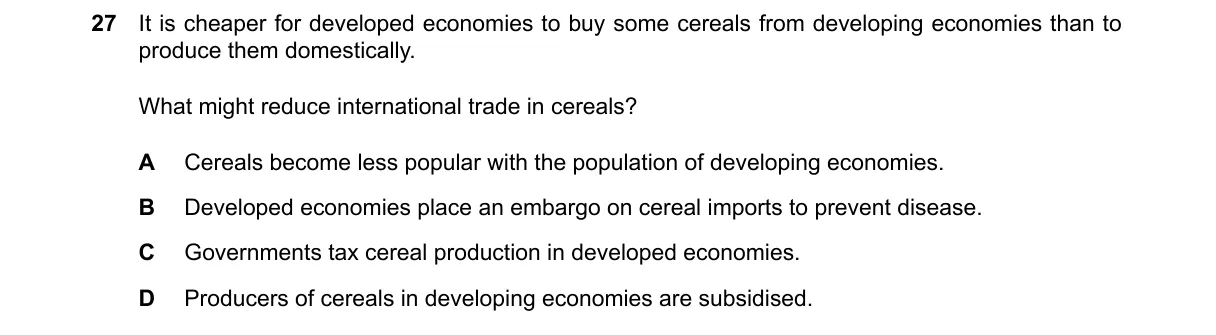
It is cheaper for developed economies to buy some cereals from developing economies than to produce them domestically. What might reduce international trade in cereals?
Answer choices
- ACereals become less popular with the population
- BDeveloped economies place an embargo on cereal imports to prevent disease
- CGovernments tax cereal production in developed economies
- DProducers of cereals in developing economies are subsidised
Explanation
Trade Barriers Disrupting Comparative Advantage
Steps:
- Establish premise: Developed economies import cereals due to lower costs abroad, driven by comparative advantage.
- Identify reduction factors: Barriers like restrictions or policy changes that increase import costs or block trade.
- Evaluate options: Assess each for impact on import volume from developing to developed economies.
- Select best: Choose direct prohibition over indirect demand or cost shifts.
Why B is correct:
- An embargo is a quantitative trade barrier that legally bans imports, directly halting international cereal trade per WTO definitions of non-tariff barriers.
Why the others are wrong:
- A: Reduced popularity lowers overall demand but does not target or block international trade specifically.
- C: Taxes on domestic production raise local costs, making imports relatively cheaper and increasing trade.
- D: Subsidies lower export prices from developing economies, enhancing competitiveness and boosting trade volume.
Final answer: B
Topic: Globalisation, free trade and protection
Practice more O Levels/IGCSE Economics (2281) questions on mMCQ.me