O Levels/IGCSE Economics (2281)•2281/11/M/J/23
O Levels/IGCSE Economics (2281) — 2281/11/M/J/23, Question 20
The government of a country operating at full employment increases its spending on education and training. How does this affect the likelihood of achieving low inflation in the short run and the long run?
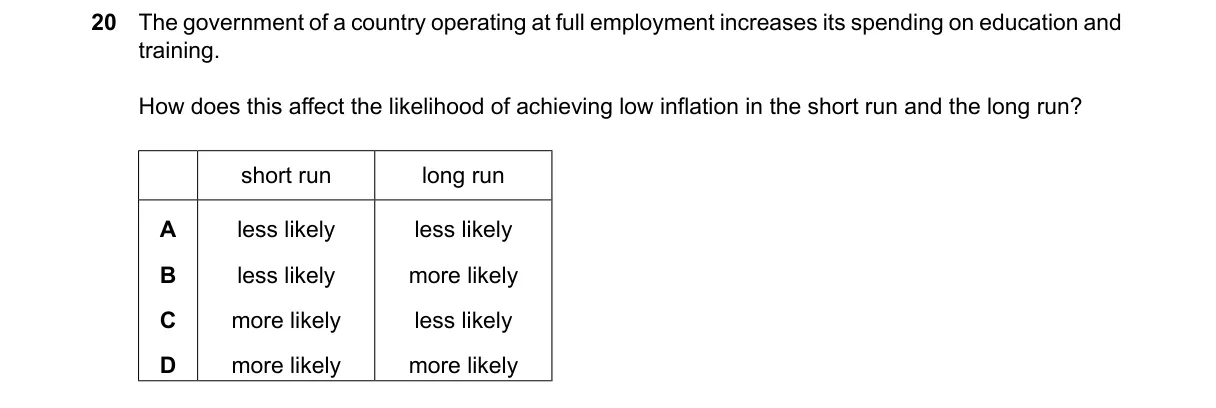
Answer choices
- Aless likely more likely
- Bless likely less likely
- Cmore likely less likely
- Dmore likely more likely
Explanation
Fiscal Expansion at Full Employment Causes Inflationary Pressure
Steps:
- Increased government spending shifts aggregate demand (AD) rightward.
- At full employment, short-run aggregate supply (SRAS) cannot expand output significantly, raising prices and inflation.
- In the long run, higher spending raises interest rates, crowding out private investment and keeping output at potential but at elevated price levels.
- Education spending's supply-side benefits emerge slowly, insufficient to offset demand pressure immediately or fully.
Why B is correct:
- Demand-pull inflation occurs in short run per AD-AS model; long-run crowding out sustains higher prices without boosting potential output quickly, per loanable funds theory.
Why the others are wrong:
- A: Long-run supply shift from education is delayed, not making low inflation more likely.
- C: Short-run demand boost makes low inflation less, not more, likely.
- D: Demand pressure reduces low inflation odds in both runs.
Final answer: B
Topic: Supply-side policy
Practice more O Levels/IGCSE Economics (2281) questions on mMCQ.me