O Levels/IGCSE Economics (2281)•2281/12/M/J/22
O Levels/IGCSE Economics (2281) — 2281/12/M/J/22, Question 30
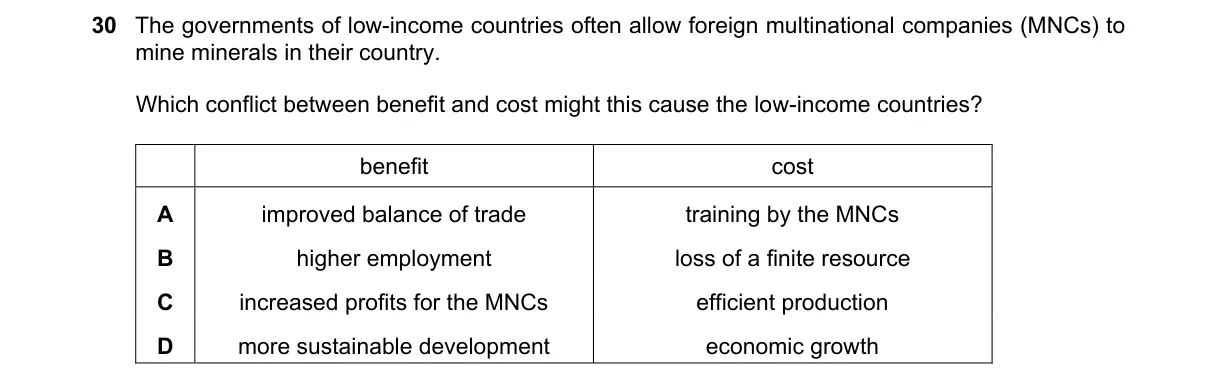
The governments of low-income countries often allow foreign multinational companies (MNCs) to mine minerals in their country. Which conflict between benefit and cost might this cause the low-income countries?
Answer choices
- Aimproved balance of trade; loss of a finite resource
- Bhigher employment; training by the MNCs
- Cincreased profits for the MNCs; efficient production
- Dmore sustainable development; economic growth
Explanation
Trade-off in resource extraction Steps:
- Identify the context: Low-income countries permit MNC mining for economic gains but face potential downsides.
- Define conflict: A true benefit-cost conflict pairs a positive outcome with a negative one for the host country.
- Evaluate choices: Scan for pairs where one is a benefit (e.g., economic boost) and the other a cost (e.g., depletion).
- Select match: Choose the option showing clear opposition between gain and loss.
Why A is correct:
- Mining exports improve trade balance by increasing foreign exchange earnings, but minerals are finite, leading to irreversible resource depletion per natural resource economics.
Why the others are wrong:
- B: Both higher employment and MNC training are benefits, with no inherent cost or conflict.
- C: MNC profits represent a cost to the host (outflow of value), but efficient production benefits MNCs more than conflicting with host interests.
- D: Sustainable development and economic growth are aligned positives, not a benefit-cost trade-off.
Final answer: A
Topic: Differences in economic development between countries
Practice more O Levels/IGCSE Economics (2281) questions on mMCQ.me