O Levels/IGCSE Economics (2281)•2281/11/M/J/22
O Levels/IGCSE Economics (2281) — 2281/11/M/J/22, Question 25
The governments of low-income countries often allow foreign multinational companies (MNCs) to mine minerals in their country. Which conflict between benefit and cost might this cause the low-income countries?
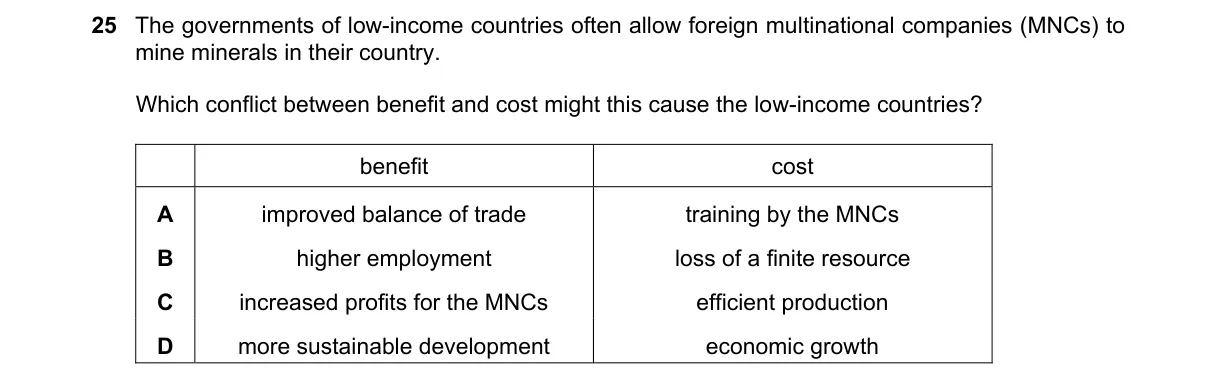
Answer choices
- Aimproved balance of trade, loss of a finite resource
- Bhigher employment, training by the MNCs
- Cincreased profits for the MNCs, inefficient production
- Dmore sustainable development, economic growth
Explanation
Resource extraction trade-offs for low-income countries
Steps:
- Identify the core issue: Allowing MNC mining provides economic benefits but incurs long-term costs like resource depletion.
- Review options: Seek a pair with one clear benefit (e.g., economic gain) and one cost (e.g., irreplaceable loss).
- Evaluate A: Improved trade balance from exports is a benefit; losing finite minerals is a cost, creating conflict.
- Confirm: This matches real-world mining economics where short-term gains clash with sustainability.
Why A is correct:
- Balance of trade improves via mineral exports (per mercantilist trade theory), but finite resources deplete without renewal, per resource economics law of non-renewable scarcity.
Why the others are wrong:
- B: Both higher employment and MNC training are benefits, lacking a cost-conflict.
- C: MNC profits and inefficient production are both costs to the host country, no benefit.
- D: Sustainable development and economic growth are both positive outcomes, no opposition.
Final answer: A
Topic: Differences in economic development between countries
Practice more O Levels/IGCSE Economics (2281) questions on mMCQ.me