O Levels/IGCSE Economics (2281)•2281/11/M/J/22
O Levels/IGCSE Economics (2281) — 2281/11/M/J/22, Question 12
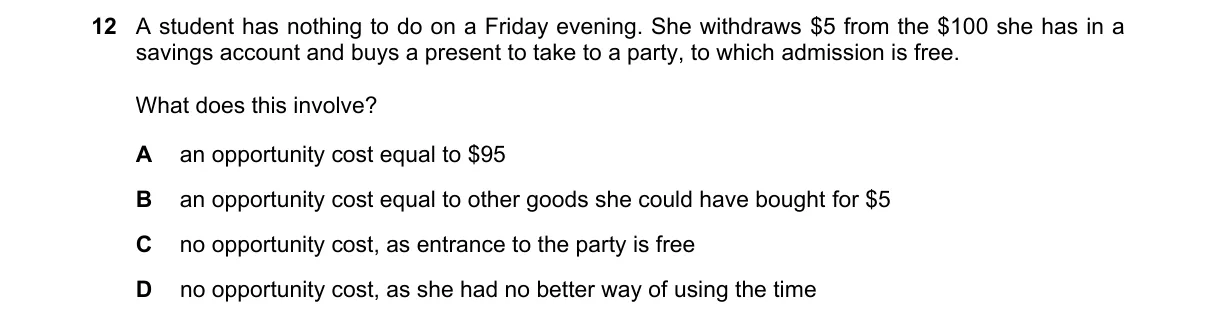
A student has nothing to do on a Friday evening. She withdraws $5 from the savings account she has in a bank and buys a present to take to a party, to which admission is free. What is this an example of?
Answer choices
- Aan opportunity cost equal to $5
- Ban opportunity cost equal to other goods she could have bought for $5
- Cno opportunity cost, as entrance to the party is free
- Dno opportunity cost, as she had no better way of using the time
Explanation
Opportunity Cost of Money Spent
Steps:
- Identify the decision: Student spends $5 on a present instead of alternatives.
- Define opportunity cost: Value of the next best use of resources forgone.
- Apply to money: The $5 could buy other goods, not just its nominal value.
- Conclude: Cost is alternatives, not the amount or time alone.
Why B is correct:
- Opportunity cost is the forgone alternatives from using scarce resources, per economic definition; here, $5 buys other goods instead of the present.
Why the others are wrong:
- A: Ignores that opportunity cost measures alternatives, not just monetary outlay.
- C: Free party entry doesn't negate the cost of the $5 present.
- D: Idle time may have low cost, but $5 withdrawal still forgoes other purchases.
Final answer: B
Topic: Opportunity cost
Practice more O Levels/IGCSE Economics (2281) questions on mMCQ.me