O Levels/IGCSE Economics (2281)•2281/12/M/J/21
O Levels/IGCSE Economics (2281) — 2281/12/M/J/21, Question 18
A country is experiencing unemployment. It has a progressive income tax policy and benefits for the poor. The government aims to increase employment and reduce income inequality. Which fiscal policy measures are most likely to achieve these aims?
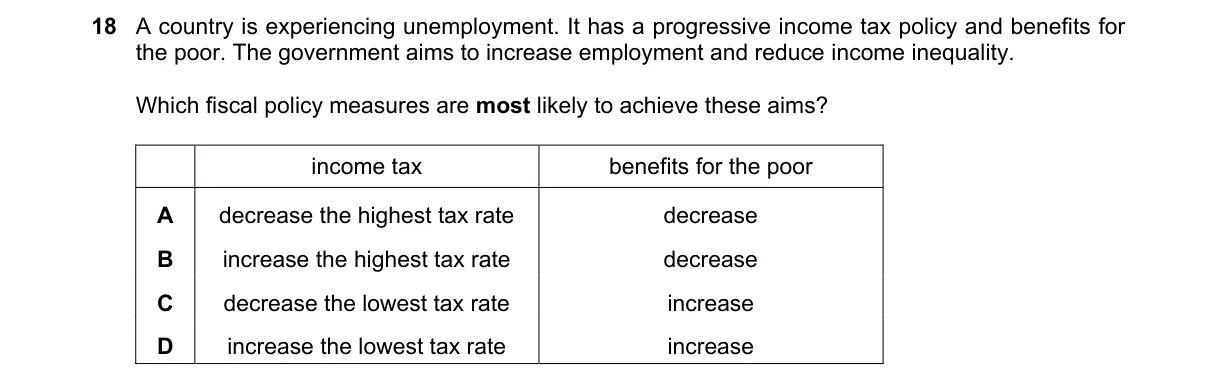
Answer choices
- Aincrease the highest tax rate; decrease benefits for the poor
- Bdecrease the highest tax rate; increase benefits for the poor
- Cdecrease the lowest tax rate; increase benefits for the poor
- Dincrease the lowest tax rate; increase benefits for the poor
Explanation
Fiscal Policy for Employment and Equity
Steps:
- Identify goals: boost employment via higher spending; reduce inequality via redistribution to low-income groups.
- Assess tax impacts: progressive system taxes higher earners more; lowering lowest rate increases low-income disposable income for consumption-driven growth.
- Evaluate benefits: raising aid to poor enhances their spending power (high multiplier) and narrows income gaps.
- Select option balancing both: tax relief for low earners spurs jobs; benefits aid equity without deterring investment.
Why C is correct:
- Decreasing lowest tax rate raises low-income disposable income, stimulating aggregate demand via Keynesian consumption multiplier; increasing benefits redistributes income, reducing Gini coefficient inequality measure.
Why the others are wrong:
- A: Raises highest tax, curbing rich's investment and employment; cuts benefits, worsening poor's consumption and inequality.
- B: Lowers highest tax, favoring rich and increasing inequality; benefits help equity but offset by regressive tax effect.
- D: Raises lowest tax, reducing poor's spending and jobs; benefits aid equity but contradicted by tax hike on vulnerable.
Final answer: C
Topic: Fiscal policy
Practice more O Levels/IGCSE Economics (2281) questions on mMCQ.me